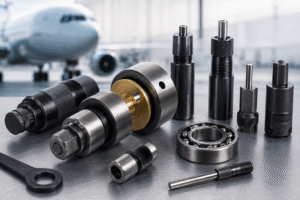



Standard swaging tools cover a large share of aerospace work. They are matched to common bearing part numbers, they fit familiar drill press and portable setups and they deliver repeatable results when the bearing, the housing and the workspace match what the tool was designed for. The trouble starts when one of those three does not match.
A bearing installed deep inside a fitting, a housing that cannot be moved to the bench, a bearing geometry outside the standard range or a production rate that demands a different setup can all push a job past what standard equipment handles well. This guide explains when custom swaging tools make sense, what drives the decision and what information a tooling supplier needs to develop a solution. For a broader look at custom tooling across installation, removal and staking, see Custom Aerospace Bearing Tools: When Standard Tooling Is Not Enough.
What Are Custom Bearing Swaging Tools?
Custom bearing swaging tools are swaging tools designed or modified for a specific application instead of a general bearing range. The customization can be as simple as a longer shank or a different pilot, or as extensive as a new tool body, roller arrangement and fixture built around one component.
The goal stays the same as with standard tooling: form the bearing’s swaging lip evenly onto the housing chamfer to meet the retention requirements of the approved procedure. What changes is how the tool reaches the bearing, how it aligns with it and how it fits the equipment and workflow in your shop. Aero Staking states that its Custom Tools can involve both new designs and modifications to existing tools.
Common Limitations of Standard Swaging Equipment
Standard tools are designed around typical conditions. They assume a bearing that can be reached from the face, a housing that can be supported and aligned, and a part that fits in the available machine or allows a portable tool to sit square to it.
When a job breaks one of these assumptions, results usually suffer before anyone calls it a tooling problem. Operators tilt the tool to reach the bearing, improvise supports or adapt a tool sized for a neighboring part number. The swage may pass inspection some of the time, but the process loses the repeatability that the tool was supposed to provide. Recurring rework, unexplained proof load failures and long setup times are often signs that the application has outgrown standard equipment.
Restricted Access and Complex Aerospace Assemblies
Access is the most frequent reason for custom tooling. Bearings in clevis fittings, actuator ends, gearbox housings or structural brackets can sit behind flanges, inside pockets or next to features that block a standard tool body. Some bearings must be swaged after other parts are assembled, which leaves very little room for the tool.
A custom design can extend reach, change the tool profile or reorient how the load is applied while keeping the rollers aligned with the bearing. For on-aircraft or large-component work, a modified Portable Tri-Roller Swaging Tool can bring the process to the part. For bench work on complex shapes, a dedicated fixture paired with a Drill Press Tri-Roller Swaging Tool can hold the housing square and supported during swaging.
Bearing Size, Geometry, and Material Considerations
Swaging tools are matched to lip geometry, so bearings outside the standard range need tools built around their dimensions. That includes unusually small or large bearings, special outer ring profiles and designs where the housing chamfer or wall thickness differs from typical values.
Materials add another layer. Housings in titanium, high-strength steel, thin-walled aluminum or composite structures respond differently to swaging loads. A custom tool can be designed with roller profiles, support and load paths suited to those materials, while the process itself stays within the limits set by the bearing specification and component drawing.
How Custom Tooling Supports Process Repeatability
Repeatability comes from removing variables the operator should not have to manage. A tool that fits the part, aligns itself with the bearing and is supported by a matching fixture leaves fewer decisions to individual technique. That matters on a production line with several operators, and it matters in MRO where a technician may perform a specific swage only a few times a year.
Custom tooling can also simplify verification. A tool designed together with its inspection and test approach makes it easier to confirm that each swage meets the procedure’s criteria. Aero Staking’s Testing Tools and the guide Bearing Swaging Quality Control cover this side of the process.
What Information Is Needed to Develop a Custom Swaging Solution?
A tooling supplier can only design around what it knows. The more complete the information you share at the start, the fewer iterations the project needs. Prepare the following before you request a quote:
- Bearing part number, specification and any special features
- Component drawing or model showing the housing, chamfer and surrounding geometry
- Housing material and wall thickness near the bore
- Access envelope around the bearing during swaging, including any parts already installed
- Single-sided or double-sided swaging requirement
- Equipment available in your shop, such as drill press, mill or portable operation
- Production volume or frequency in MRO
- Verification requirements, including proof load and inspection steps
- Current problems with standard tooling, with photos or rejected part data if available
Share only information your organization allows you to release. If drawings are controlled, ask about the supplier’s process for handling them before sending files.
Standard vs Custom Swaging Tooling: Application Comparison
| Consideration | Standard swaging tools | Custom swaging tools |
|---|---|---|
| Bearing range | Common part numbers and sizes | Special sizes, profiles or geometries |
| Access | Bearing face is open and reachable | Restricted, deep or partially blocked access |
| Housing | Typical materials and wall thickness | Thin walls, special materials, unusual chamfers |
| Setup | Standard drill press or portable use | Dedicated fixtures or modified configuration |
| Lead time | Shorter, depending on availability | Longer, includes design and validation |
| Best fit | Routine production and MRO | Recurring problem parts and specialized programs |
Frequently Asked Questions
How do I know if I need a custom swaging tool?
Look for recurring signs: operators improvising to reach the bearing, inconsistent swage results, frequent rework or setup times out of proportion to the job. If standard tooling cannot sit square to the bearing, a custom solution is worth evaluating.
Can an existing swaging tool be modified instead of designing a new one?
Often, yes. Aero Staking’s Custom Tools page notes that projects can involve modifying an existing tool. The supplier can evaluate which option fits your application.
How long does a custom swaging tool take to develop?
It depends on complexity, design iterations and validation. Ask for a timeline when you request a quote.
Do custom tools change the swaging requirements?
No. Custom tooling changes how the swage is performed, not the acceptance criteria. Retention, dimensional and proof load requirements come from the applicable specification and documentation.
Who should be involved in a custom tooling request?
Typically manufacturing or MRO engineering, quality and the technicians who will use the tool. Purchasing joins to manage the quote and approval.
Conclusion
The cost of a custom swaging tool is easy to see on a quote. The cost of not having one is spread across rework, extra setup time, failed tests and housings that cannot be repaired again. Comparing the two is the most practical way to decide.
Start with the component that causes your team the most difficulty. Gather the bearing data, drawing, access constraints and current results, and review them with a tooling supplier that designs and manufactures swaging tools. Visit Aero Staking’s Custom Tools page or contact Aero Staking to discuss your application and request a quote.